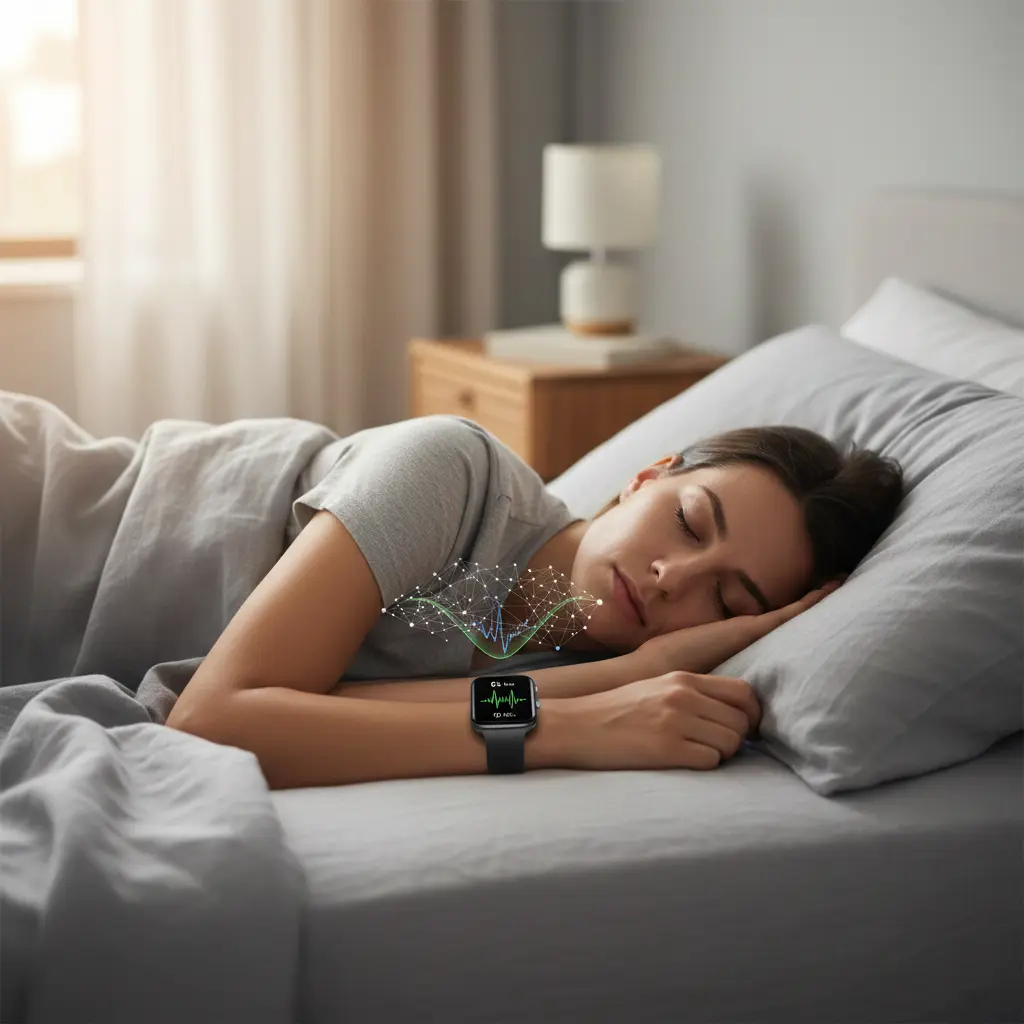
Wearables have evolved into powerful health-tracking tools. Supported by artificial intelligence (AI), they can help identify patterns associated with possible sleep apnea—providing early awareness and prompting users to seek professional evaluation.
Understanding PPG and Apnea Patterns
Photoplethysmography (PPG) is a common wearable sensor method. During sleep apnea events, changes occur in:
• Heart rate
• Oxygen saturation
• Pulse wave amplitude
• Respiratory variability
Machine learning models can analyse these combined signals to estimate apnea risk.
Notable Research — The ApSense Model
The ApSense deep-learning model evaluates raw PPG data to generate predicted AHI (pAHI). Research shows:
• High accuracy for identifying moderate to severe OSA
• Good potential for large-scale population screening
• Practical compatibility with low-cost sensors
While not intended for clinical diagnosis, such models improve early awareness.
Benefits of Wearable-Based Screening
• Non-invasive
• Low cost
• Multi-night data provides broader insights
• Helps individuals recognise symptoms early
• Reduces strain on sleep laboratories
• Useful for countries with limited diagnostic infrastructure
Limitations
• Wearables vary in sensor quality
• Algorithms may require device-specific calibration
• Not a replacement for formal sleep studies
Conclusion
AI-driven wearable screening tools are emerging as valuable early-detection aids. They empower individuals to seek timely clinical evaluation and contribute to wider awareness of sleep apnea.
References
1. ApSense Model Research (arXiv).
2. Peer-reviewed studies on PPG and sleep-related breathing disorders.
Medical Disclaimer
Wearable devices and AI tools cannot diagnose sleep apnea. This article is for awareness and should not replace consultation with sleep medicine professionals.