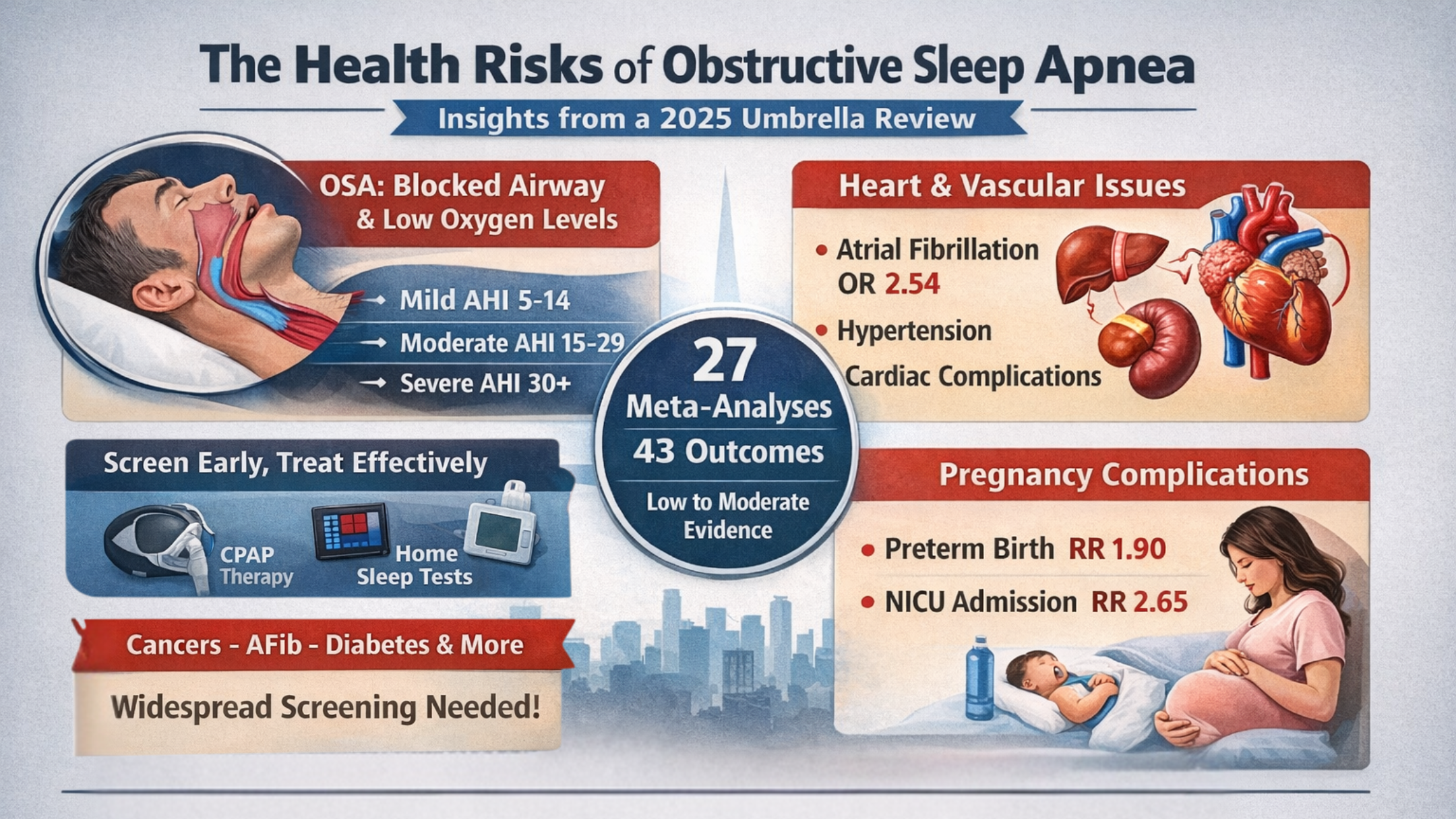
Obstructive sleep apnea (OSA) casts a wide shadow over health, strongly associating with cancers, atrial fibrillation, diabetes, osteoporosis, and more, as evidenced by a 2025 Frontiers in Medicine umbrella review synthesising 27 meta-analyses from 43 outcomes. This high-level synthesis grades the evidence as as low-to-moderate but underscores the dose-dependent risks, urging widespread screening for at-risk adults to mitigate these threats early.
Defining OSA and Its Measurement
Obstructive sleep apnea occurs when throat muscles relax excessively during sleep, blocking the airway and causing pauses in breathing that fragment sleep and drop oxygen levels. Severity classifies by apnea-hypopnea index (AHI): mild 5-14.9, moderate 15-29.9, severe ≥30 events/hour, with risks escalating nonlinearly. Globally, OSA impacts 936 million adults, yet 80% remain undiagnosed due to symptoms like snoring and fatigue mimicking aging.
Umbrella Review Methodology Rigor
Authors searched PubMed, Embase, Web of Science through December 2023, applying AMSTAR 2 for quality (median 9/16, moderate) and GRADE for certainty (mostly low from heterogeneity I²>50%). Inclusion spanned 27 SRs/MAs on observational data, focusing mean differences, odds ratios (OR), relative risks (RR), hazard ratios (HR). Exclusions: poor methodology, animal studies; subgroup analyses by severity, APAP use, follow-up >5 years.
Oncology Links: Cancers Under the Spotlight
Overall cancer RR 1.42 (95% CI 1.26-1.60, I²=42%), dose-response clear: mild RR 1.14, severe 1.59. Standouts include thyroid HR 2.32 (1.83-2.95), kidney RR 1.81 (1.26-2.60), liver 1.19 (1.05-1.34); mechanisms implicate VEGF angiogenesis from intermittent hypoxia. Long-term cohorts (>10 years) confirm pancreatic HR 1.53, colorectal 1.24; APAP users show attenuated risks.
Cardiovascular and Arrhythmic Burdens
Atrial fibrillation OR 2.54 (2.17-2.97, I²=62%), per-AHI increase OR 1.26%; resistant hypertension OR 2.84. Postoperative cohorts highlight delirium OR 3.73, respiratory failure 1.92, cardiac 1.74—critical for surgical planning. GRADE low-moderate; funnel plots symmetric, no bias.
Metabolic, Endocrine, and Skeletal Risks
Diabetes OR 1.40 (1.28-1.53), metabolic syndrome 2.87; osteoporosis OR 2.03 (1.55-2.65). GERD OR 1.53, NAFLD RR 1.81; postmenopausal women face compounded bone loss HR 1.92. Pregnancy outcomes grim: preterm RR 1.90, C-section 1.87, NICU 2.65.
| Category | Key Outcome | Effect Size (95% CI) | GRADE frontiersin |
| Cancer | Thyroid | HR 2.32 (1.83-2.95) | Low |
| Cardio | AFib | OR 2.54 (2.17-2.97) | Moderate |
| Metabolic | Diabetes | OR 1.40 (1.28-1.53) | Low |
| Pregnancy | Preterm | RR 1.90 (1.43-2.52) | Very Low |
Mechanistic Underpinnings Across Systems
Chronic intermittent hypoxia/indicator reoxygenation sparks oxidative stress, NLRP3 inflammasome, endothelial dysfunction; sympathetic overdrive elevates BP. APAP mitigates by stabilizing oxygenation, reducing biomarkers 30-50%; weight loss synergizes. Limitations: observational bias, few high-certainty RCTs.
Screening and Mitigation Strategies
High-risk: BMI>30, age>50, hypertension; home oximetry sensitivity 85%. CPAP first-line (adherence >4h/night halves risks), positional therapy mild, surgery select. Cost-effective: $5k/QALY cancer prevention.