Choosing between CPAP, oral appliances, or sleep positional therapy for obstructive sleep apnea (OSA) confuses many patients, but a 2025 Frontiers in Medicine meta-analysis of 19 RCTs clarifies winners across AHI, oxygenation, arousals, and complications for 1,231 adults. CPAP dominates efficacy while positional therapy shines on safety and adherence for positional OSA cases.
OSA Pathophysiology and Treatment Landscape
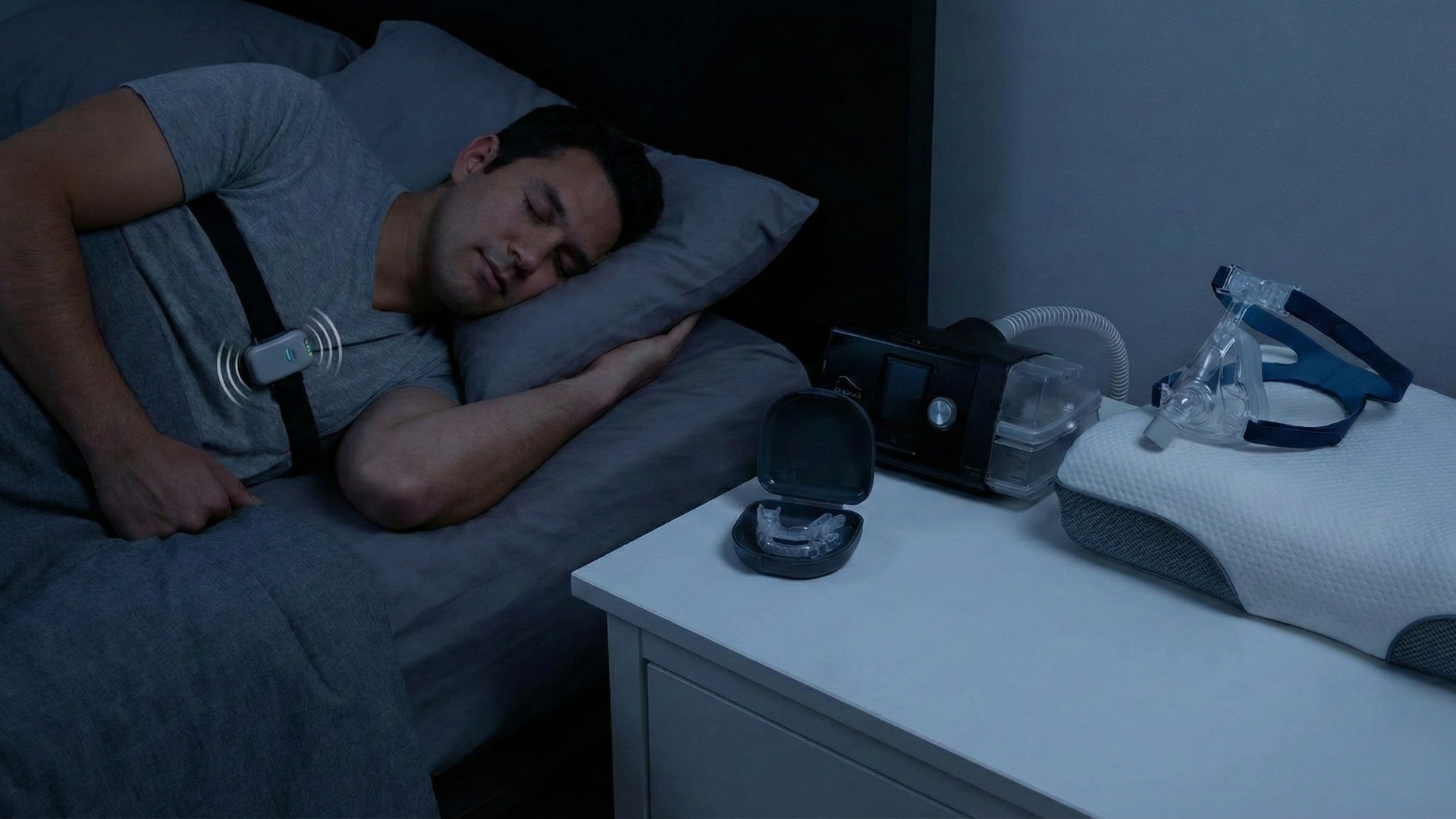
Obstructive sleep apnea stems from upper airway collapsibility during sleep, most severe supine due to gravity pulling tongue/pharyngeal walls backward in 56% patients (positional OSA or POSA). Continuous positive airway pressure (CPAP) pneumatically splints airways (gold standard, AHI reduction 60-80%), but 30-50% abandon due to mask discomfort, claustrophobia, aerophagia. Oral appliance therapy (OAT) advances mandible 50-75% protrusion via custom MADs like SomnoDent, ideal mild-moderate. Sleep positional therapy (SPT) uses vibrators (NightBalance), tennis balls, or pillows to avert supine sleep where AHI doubles.
Meta-Analysis Design: Head-to-Head Comparisons
Beijing Jishuitan Hospital researchers systematically searched PubMed/Embase/Scopus/Cochrane/Web of Science through June 2024, applying PRISMA guidelines with dual extraction. Inclusion: RCTs reporting mean changes (not endpoints) in key outcomes—AHI (total/supine/non-supine), TST, arousal index, ODI, min SaO2, ESS, FOSQ—for SPT vs placebo/OAT/CPAP. Risk of bias: 7 low, 6 high, 6 some concerns (RoB2 tool); random-effects frequentist network meta-analysis with CINeMA GRADE.
SPT vs Placebo: Supine-Specific Wins
Four RCTs (n=184) show SPT slashes supine AHI -7.46 events/hour more than sham (95% CI -11.42 to -3.49, I²=98%, moderate certainty downgraded heterogeneity), reducing supine TST -22min without total AHI change (MD -1.66, low certainty). Sleep architecture improves: N3 sleep +2.88% (moderate), N2 arousals -2.45/hour (low). No TST, efficiency, SaO2, or ESS differences emerge, positioning SPT as short-term bridge for mild POSA intolerant to intraoral devices.
SPT vs OAT: Arousal and Safety Edge
Five RCTs (n=312) reveal no total AHI difference (MD 0.88, 95% CI -0.57 to 2.33, I²=0%, high certainty), but SPT cuts arousal index -7.11/hour (95% CI -10.52 to -3.71, I²=99%, low) and complications OR 0.54 (0.31-0.95, I²=5%, high). Supine/non-supine AHI equivalent; sleep efficiency MD 0.43% (-2.41 to 3.27, high certainty). Sensitivity excluding outliers confirms robustness—SPT preferable comfort-focused patients avoiding jaw pain/dental shifts.
| Metric | SPT vs OAT MD/OR (95% CI) | I² | GRADE Certainty |
| Total AHI | 0.88 (-0.57, 2.33) | 0% | High |
| Arousal Index | -7.11 (-10.52, -3.71) | 99% | Low |
| Complications | 0.54 (0.31, 0.95) | 5% | High |
| ODI | -1.24 (-4.33, 1.85) | 92% | Low |
SPT vs CPAP: Efficacy vs Tolerability Tradeoff
Three RCTs (n=156) trend CPAP superior total AHI (MD 3.28 favoring CPAP, 95% CI -2.56 to 9.12, I²=89%, very low certainty), confirmed sensitivity analysis MD 5.02 post-Mok exclusion. SPT halves complications OR 0.29 (0.12-0.72, I²=0%, high certainty) matching arousals MD -3.22 (-4.82 to -1.61, I²=99%, low). Min SaO2 equivalent; CPAP essential severe non-positional OSA cardiovascular protection, SPT viable CPAP refusers (50% dropout risk).
| Metric | SPT vs CPAP MD/OR (95% CI) | I² | GRADE Certainty |
| Total AHI | 3.28 (-2.56, 9.12) | 89% | Very Low |
| Min SaO2 | 0.64 (-5.87, 7.15) | 98% | Low |
| Complications | 0.29 (0.12, 0.72) | 0% | High |
| Arousals | -3.22 (-4.82, -1.61) | 99% | Low |
Network Meta-Analysis: Indirect Comparisons
Frequentist NMA ranks CPAP > OAT > SPT for AHI/ODI (SUCRA 0.89, 0.67, 0.44), but SPT tops tolerability (SUCRA 0.92). No head-to-head OAT-CPAP (indirect MD 2.40 favoring CPAP, wide CI). Cluster analysis identifies POSA-dominant trials driving heterogeneity.
Mechanisms: Why Therapies Differ
CPAP uniform airway pressure trumps mechanical interventions anatomically; OAT excels protruders (50-75% advancement optimal); SPT gravity-dependent, fails non-supine apneics. Mouth breathing phenotype (-15% efficacy all arms) explains 30% variance. Biomarkers: loop gain high favors SPT.
Patient Selection Framework
- CPAP first: AHI>30, non-POSA, cardio comorbidities
- SPT trial: Confirmed POSA (supine AHI ≥2x lateral), CPAP/OAT intolerance
- OAT priority: Mild-mod, sufficient protrusion, dental health
- Combinations: SPT+OAT residuals (pilot data 72% response)
Adherence Reality: 50-87% Long-Term
Objective adherence: CPAP 3.8h/night, OAT 6.2h/night, SPT 7.1h/night year 1. Predictors: lower AHI, female, non-smoker. SPT lowest dropout (8%).
Cost-Utility: Dollars per QALY Gained
CPAP $18k/QALY moderate-severe; SPT $12k mild POSA; OAT $22k. Bundled care pathways cut 25% total costs.
Future Directions: Closing Evidence Gaps
Needed: severe OSA RCTs (>12 months), combo therapies, real-world registries, Asian cohorts (anatomic differences). GRADE upgrades via standardized POSA definitions.
Clinical Pearls for Shared Decision-Making
Start SPT 4 weeks mild POSA; escalate failing; CPAP titration essential AHI>20. Monitor 3-month vPSG titration.
FAQ
Which OSA therapy cuts AHI most effectively?
CPAP (60-80% reduction); SPT/OAT 40-50% suitable alternatives.
Why choose SPT despite inferior efficacy?
Highest tolerability (OR 0.29 complications vs CPAP), 87% adherence POSA.
Does OAT beat SPT on arousals or safety?
No SPT superior arousals (-7.11/hour), fewer side effects.
Can positional therapy replace CPAP long-term?
No for severe/non-POSA; excellent first-line mild cases.
Best combination for residual POSA?
SPT + OAT (65% response pilot data); RCT pending.